


Page 19 - Demo
P. 19
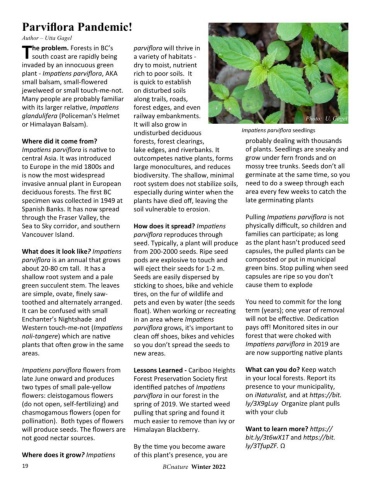
BCnature Winter 202219Parviflora Pandemic!Author – Utta GagelThe problem. Forests in BC’s south coast are rapidly being invaded by an innocuous green plant - Impatiens parviflora, AKA small balsam, small-flowered jewelweed or small touch-me-not. Many people are probably familiar with its larger relative, Impatiens glandulifera (Policeman's Helmet or Himalayan Balsam).Where did it come from? Impatiens parviflora is native to central Asia. It was introduced to Europe in the mid 1800s and is now the most widespread invasive annual plant in European deciduous forests. The first BC specimen was collected in 1949 at Spanish Banks. It has now spread through the Fraser Valley, the Sea to Sky corridor, and southern Vancouver Island.What does it look like? Impatiens parviflora is an annual that grows about 20-80 cm tall. It has a shallow root system and a pale green succulent stem. The leaves are simple, ovate, finely saw-toothed and alternately arranged. It can be confused with small Enchanter’s Nightshade and Western touch-me-not (Impatiens noli-tangere) which are native plants that often grow in the same areas.Impatiens parviflora flowers from late June onward and produces two types of small pale-yellow flowers: cleistogamous flowers (do not open, self-fertilizing) and chasmogamous flowers (open for pollination). Both types of flowers will produce seeds. The flowers are Himalayan Blackberry. not good nectar sources.Where does it grow? Impatiens parviflora will thrive in a variety of habitats - dry to moist, nutrient rich to poor soils. It is quick to establish on disturbed soils along trails, roads, forest edges, and even railway embankments. It will also grow in undisturbed deciduous forests, forest clearings, lake edges, and riverbanks. It outcompetes native plants, forms large monocultures, and reduces biodiversity. The shallow, minimal root system does not stabilize soils, need to do a sweep through each especially during winter when the plants have died off leaving the ,soil vulnerable to erosion. How does it spread? Impatiens parviflora reproduces through seed. Typically, a plant will produce as the plant hasn’t produced seed from 200-2000 seeds. Ripe seed pods are explosive to touch and will eject their seeds for 1-2 m. Seeds are easily dispersed by sticking to shoes, bike and vehicle tires, on the fur of wildlife and pets and even by water (the seeds float). When working or recreating in an area where Impatiens parviflora grows, it's important to clean off shoes, bikes and vehicles so you don’t spread the seeds to new areas.Lessons Learned - Cariboo Heights Forest Preservation Society first identified patches of Impatiens parviflora in our forest in the spring of 2019. We started weed pulling that spring and found it much easier to remove than ivy or By the time you become aware of this plant s presence, you are 'probably dealing with thousands of plants. Seedlings are sneaky and grow under fern fronds and on mossy tree trunks. Seeds don’t all germinate at the same time, so you area every few weeks to catch the late germinating plantsPulling Impatiens parviflora is not physically difficult, so children and families can participate; as long capsules, the pulled plants can be composted or put in municipal green bins. Stop pulling when seed capsules are ripe so you don't cause them to explodeYou need to commit for the long term (years); one year of removal will not be effective. Dedication pays off! Monitored sites in our forest that were choked with Impatiens parviflora in 2019 are are now supporting native plantsWhat can you do? Keep watch in your local forests. Report its presence to your municipality, on iNaturalist, and at https://bit.ly/3X9gLuy Organize plant pulls with your club Want to learn more? https://bit.ly/3t6wX1T and https://bit.ly/3TfupZF. ΩPhoto: U. GagelImpatiens parviflora seedlings


