


Page 22 - Demo
P. 22
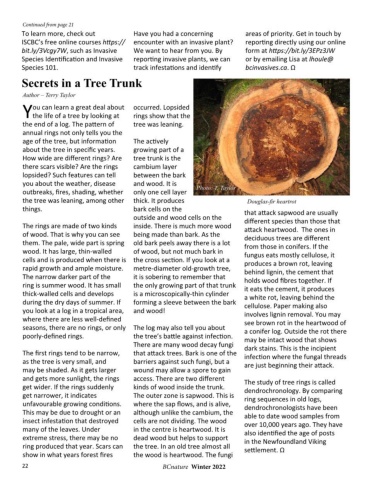
BCnature Winter 202222Secrets in a Tree TrunkAuthor – Terry TaylorYou can learn a great deal about the life of a tree by looking at the end of a log. The pattern of annual rings not only tells you the age of the tree, but information about the tree in specific years. How wide are different rings? Are there scars visible? Are the rings lopsided? Such features can tell you about the weather, disease outbreaks, fires, shading, whether the tree was leaning, among other things.The rings are made of two kinds of wood. That is why you can see them. The pale, wide part is spring wood. It has large, thin-walled cells and is produced when there is the cross section. If you look at a rapid growth and ample moisture. The narrow darker part of the ring is summer wood. It has small thick-walled cells and develops during the dry days of summer. If you look at a log in a tropical area, where there are less well-defined seasons, there are no rings, or only poorly defined rings. -The first rings tend to be narrow, as the tree is very small, and may be shaded. As it gets larger and gets more sunlight, the rings get wider. If the rings suddenly get narrower, it indicates unfavourable growing conditions. This may be due to drought or an insect infestation that destroyed many of the leaves. Under extreme stress, there may be no ring produced that year. Scars can show in what years forest fires occurred. Lopsided rings show that the tree was leaning.The actively growing part of a tree trunk is the cambium layer between the bark and wood. It is only one cell layer thick. It produces bark cells on the outside and wood cells on the inside. There is much more wood being made than bark. As the old bark peels away there is a lot of wood, but not much bark in metre-diameter old-growth tree, it is sobering to remember that the only growing part of that trunk is a microscopically-thin cylinder forming a sleeve between the bark and wood! The log may also tell you about the tree’s battle against infection. There are many wood decay fungi that attack trees. Bark is one of the barriers against such fungi, but a wound may allow a spore to gain access. There are two different kinds of wood inside the trunk. The outer zone is sapwood. This is where the sap flows, and is alive, although unlike the cambium, the cells are not dividing. The wood in the centre is heartwood. It is dead wood but helps to support the tree. In an old tree almost all the wood is heartwood. The fungi that attack sapwood are usually different species than those that attack heartwood. The ones in deciduous trees are different from those in conifers. If the fungus eats mostly cellulose, it produces a brown rot, leaving behind lignin, the cement that holds wood fibres together. If it eats the cement, it produces a white rot, leaving behind the cellulose. Paper making also involves lignin removal. You may see brown rot in the heartwood of a conifer log. Outside the rot there may be intact wood that shows dark stains. This is the incipient infection where the fungal threads are just beginning their attack. The study of tree rings is called dendrochronology. By comparing ring sequences in old logs, dendrochronologists have been able to date wood samples from over 10,000 years ago. They have also identified the age of posts in the Newfoundland Viking settlement. Ω To learn more, check out ISCBC’s free online courses https://bit.ly/3Vcgy7W, such as Invasive Species Identification and Invasive Species 101.Have you had a concerning encounter with an invasive plant? We want to hear from you. By reporting invasive plants, we can track infestations and identify areas of priority. Get in touch by reporting directly using our online form at https://bit.ly/3EPz3JW or by emailing Lisa at lhoule@bcinvasives.ca. Ω Continued from page 21Photo: T. TaylorDouglas-fir heartrot


