


Page 13 - Demo
P. 13
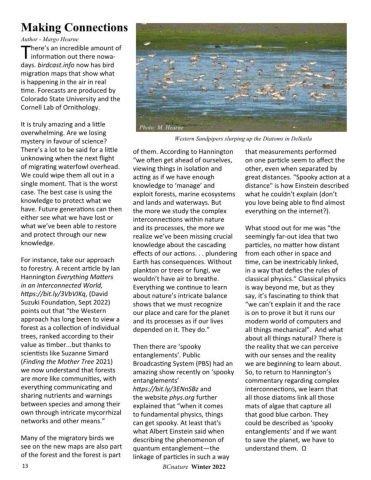
BCnature Winter 202213There’s an incredible amount of information out there nowa-days. birdcast.info now has bird migration maps that show what is happening in the air in real time. Forecasts are produced by Colorado State University and the Cornell Lab of Ornithology. It is truly amazing and a little overwhelming. Are we losing mystery in favour of science? There’s a lot to be said for a little unknowing when the next flight of migrating waterfowl overhead. We could wipe them all out in a single moment. That is the worst case. The best case is using the knowledge to protect what we have. Future generations can then either see what we have lost or what we’ve been able to restore and protect through our new knowledge.For instance, take our approach to forestry. A recent article by Ian Hannington Everything Matters in an Interconnected World, https://bit.ly/3VbVJKq, (David Suzuki Foundation, Sept 2022) points out that “the Western approach has long been to view a forest as a collection of individual trees, ranked according to their value as timber...but thanks to scientists like Suzanne Simard (Finding the Mother Tree 2021) we now understand that forests are more like communities, with everything communicating and sharing nutrients and warnings between species and among their own through intricate mycorrhizal networks and other means.”Many of the migratory birds we see on the new maps are also part of the forest and the forest is part of them. According to Hannington “we often get ahead of ourselves, viewing things in isolation and acting as if we have enough knowledge to ‘manage’ and exploit forests, marine ecosystems and lands and waterways. But the more we study the complex interconnections within nature and its processes, the more we realize we’ve been missing crucial knowledge about the cascading effects of our actions. . . plundering from each other in space and Earth has consequences. Without plankton or trees or fungi, we wouldn’t have air to breathe. Everything we continue to learn about nature’s intricate balance shows that we must recognize our place and care for the planet and its processes as if our lives depended on it. They do.”Then there are ‘spooky entanglements’. Public Broadcasting System (PBS) had an amazing show recently on ‘spooky entanglements’ https://bit.ly/3ENnSBz and the website phys.org further explained that “when it comes to fundamental physics, things can get spooky. At least that's what Albert Einstein said when describing the phenomenon of quantum entanglement—the linkage of particles in such a way that measurements performed on one particle seem to affect the other, even when separated by great distances. \Spooky action at a distance\ is how Einstein described what he couldn't explain (don’t you love being able to find almost everything on the internet?).What stood out for me was “the seemingly far-out idea that two particles, no matter how distant time, can be inextricably linked, in a way that defies the rules of classical physics.” Classical physics is way beyond me, but as they say, it’s fascinating to think that “we can’t explain it and the race is on to prove it but it runs our modern world of computers and all things mechanical”. And what about all things natural? There is the reality that we can perceive with our senses and the reality we are beginning to learn about. So, to return to Hannington’s commentary regarding complex interconnections, we learn that all those diatoms link all those mats of algae that capture all that good blue carbon. They could be described as ‘spooky entanglements’ and if we want to save the planet, we have to understand them. ΩMaking ConnectionsAuthor - Margo Hearne Western Sandpipers slurping up the Diatoms in DelkatlaPhoto: M. Hearne


