


Page 17 - Demo
P. 17
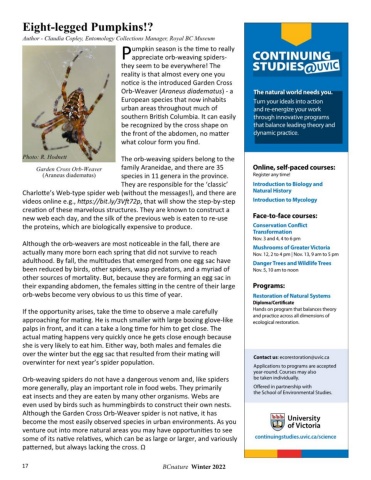
BCnature Winter 202217Eight-legged Pumpkins!? Author - Claudia Copley, Entomology Collections Manager, Royal BC MuseumPumpkin season is the time to really appreciate orb-weaving spiders- they seem to be everywhere! The reality is that almost every one you notice is the introduced Garden Cross Orb-Weaver (Araneus diadematus ) - a European species that now inhabits urban areas throughout much of southern British Columbia. It can easily be recognized by the cross shape on the front of the abdomen, no matter what colour form you find. The orb-weaving spiders belong to the family Araneidae, and there are 35 species in 11 genera in the province. They are responsible for the ‘classic’ Charlotte’s Web-type spider web (without the messages!), and there are videos online e.g., https://bit.ly/3Vft72p, that will show the step-by-step creation of these marvelous structures. They are known to construct a new web each day, and the silk of the previous web is eaten to re-use the proteins, which are biologically expensive to produce. Although the orb-weavers are most noticeable in the fall, there are actually many more born each spring that did not survive to reach adulthood. By fall, the multitudes that emerged from one egg sac have been reduced by birds, other spiders, wasp predators, and a myriad of other sources of mortality. But, because they are forming an egg sac in their expanding abdomen, the females sitting in the centre of their large orb-webs become very obvious to us this time of year. If the opportunity arises, take the time to observe a male carefully approaching for mating. He is much smaller with large boxing glove-like palps in front, and it can a take a long time for him to get close. The actual mating happens very quickly once he gets close enough because she is very likely to eat him. Either way, both males and females die over the winter but the egg sac that resulted from their mating will overwinter for next year’s spider population. Orb-weaving spiders do not have a dangerous venom and, like spiders more generally, play an important role in food webs. They primarily eat insects and they are eaten by many other organisms. Webs are even used by birds such as hummingbirds to construct their own nests. Although the Garden Cross Orb-Weaver spider is not native, it has become the most easily observed species in urban environments. As you venture out into more natural areas you may have opportunities to see some of its native relatives, which can be as large or larger, and variously patterned, but always lacking the cross. Ω continuingstudies.uvic.ca/scienceThe natural world needs you.Turn your ideals into action and re-energize your work through innovative programs that balance leading theory and dynamic practice. Contact us: ecorestoration@uvic.ca Applications to programs are accepted year-round. Courses may also be taken individually. Offered in partnership with the School of Environmental Studies.Online, self-paced courses: Register any time! Introduction to Biology and Natural History Introduction to Mycology Face-to-face courses: Conservation Conflict Transformation Nov. 3 and 4, 4 to 6 pm Mushrooms of Greater Victoria Nov. 12, 2 to 4 pm | Nov. 13, 9 am to 5 pm Danger Trees and Wildlife Trees Nov. 5, 10 am to noon Programs: Restoration of Natural Systems Diploma/Certificate Hands on program that balances theory and practice across all dimensions of ecological restoration.Garden Cross Orb-Weaver (Araneus diadematus) Photo: R. Hodnett


