


Page 21 - Demo
P. 21
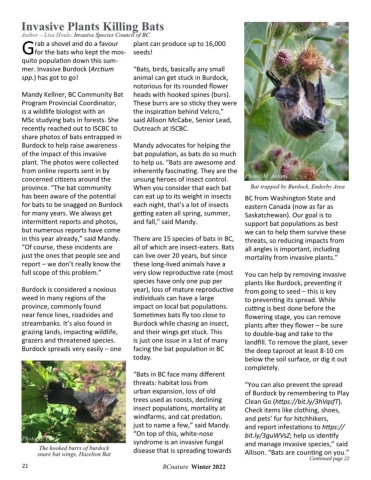
BCnature Winter 202221Invasive Plants Killing Bats Author – Lisa Houle, Invasive Species Council of BC Grab a shovel and do a favour for the bats who kept the mos-quito population down this sum-mer. Invasive Burdock (Arctium spp.) has got to go!Mandy Kellner, BC Community Bat Program Provincial Coordinator, is a wildlife biologist with an MSc studying bats in forests. She recently reached out to ISCBC to share photos of bats entrapped in Burdock to help raise awareness of the impact of this invasive plant. The photos were collected from online reports sent in by concerned citizens around the province. “The bat community has been aware of the potential for bats to be snagged on Burdock for many years. We always get intermittent reports and photos, but numerous reports have come in this year already,” said Mandy. “Of course, these incidents are just the ones that people see and report – we don’t really know the full scope of this problem.”Burdock is considered a noxious weed in many regions of the province, commonly found near fence lines, roadsides and streambanks. It’s also found in grazing lands, impacting wildlife, grazers and threatened species. Burdock spreads very easily – one plant can produce up to 16,000 seeds!“Bats, birds, basically any small animal can get stuck in Burdock, notorious for its rounded flower heads with hooked spines (burs). These burrs are so sticky they were the inspiration behind Velcro,” said Allison McCabe, Senior Lead, Outreach at ISCBC.Mandy advocates for helping the bat population, as bats do so much to help us. “Bats are awesome and inherently fascinating. They are the unsung heroes of insect control. When you consider that each bat can eat up to its weight in insects each night, that’s a lot of insects getting eaten all spring, summer, and fall,” said Mandy.There are 15 species of bats in BC, all of which are insect-eaters. Bats can live over 20 years, but since these long-lived animals have a very slow reproductive rate (most species have only one pup per year), loss of mature reproductive individuals can have a large impact on local bat populations. Sometimes bats fly too close to Burdock while chasing an insect, and their wings get stuck. This is just one issue in a list of many facing the bat population in BC today.“Bats in BC face many different threats: habitat loss from urban expansion, loss of old trees used as roosts, declining insect populations, mortality at windfarms and cat predation, ,just to name a few,” said Mandy. “On top of this, white-nose syndrome is an invasive fungal disease that is spreading towards BC from Washington State and eastern Canada (now as far as Saskatchewan). Our goal is to support bat populations as best we can to help them survive these threats, so reducing impacts from all angles is important, including mortality from invasive plants.” You can help by removing invasive plants like Burdock, preventing it from going to seed – this is key to preventing its spread. While cutting is best done before the flowering stage, you can remove plants after they flower – be sure to double-bag and take to the landfill. To remove the plant, sever the deep taproot at least 8-10 cm below the soil surface, or dig it out completely.“You can also prevent the spread of Burdock by remembering to Play Clean Go (https://bit.ly/3hVqsfT). Check items like clothing, shoes, and pets’ fur for hitchhikers, and report infestations to https://bit.ly/3guWVsZ; help us identify and manage invasive species,” said Allison. “Bats are counting on you.”The hooked burrs of burdock snare bat wings, Hazelton BatPhoto: S. CarlePhoto: M. AnionsBat trapped by Burdock, Enderby AreaContinued page 22


