


Page 23 - Demo
P. 23
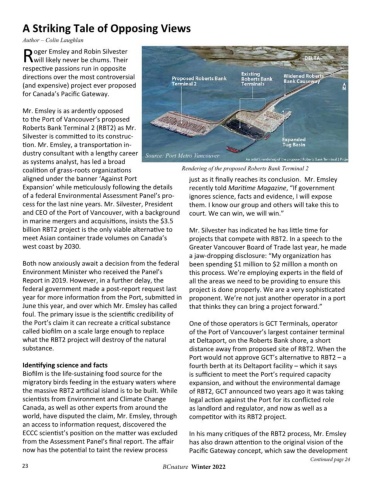
BCnature Winter 202223A Striking Tale of Opposing ViewsAuthor – Colin LaughlanRoger Emsley and Robin Silvester will likely never be chums. Their respective passions run in opposite directions over the most controversial (and expensive) project ever proposed for Canada’s Pacific Gateway. Mr. Emsley is as ardently opposed to the Port of Vancouver’s proposed Roberts Bank Terminal 2 (RBT2) as Mr. Silvester is committed to its construc-tion. Mr. Emsley, a transportation in-dustry consultant with a lengthy career as systems analyst, has led a broad coalition of grass-roots organizations aligned under the banner ‘Against Port Expansion’ while meticulously following the details of a federal Environmental Assessment Panel’s pro-cess for the last nine years. Mr. Silvester, President and CEO of the Port of Vancouver, with a background in marine mergers and acquisitions, insists the $3.5 billion RBT2 project is the only viable alternative to meet Asian container trade volumes on Canada’s west coast by 2030.Both now anxiously await a decision from the federal Environment Minister who received the Panel’s Report in 2019. However, in a further delay, the federal government made a post-report request last year for more information from the Port, submitted in proponent. We’re not just another operator in a port June this year, and over which Mr. Emsley has called foul. The primary issue is the scientific credibility of the Port’s claim it can recreate a critical substance called biofilm on a scale large enough to replace what the RBT2 project will destroy of the natural substance. Identifying science and factsBiofilm is the life-sustaining food source for the migratory birds feeding in the estuary waters where the massive RBT2 artificial island is to be built. While scientists from Environment and Climate Change Canada, as well as other experts from around the world, have disputed the claim, Mr. Emsley, through an access to information request, discovered the ECCC scientist’s position on the matter was excluded from the Assessment Panel’s final report. The affair now has the potential to taint the review process just as it finally reache its conclusion. Mr. Emsley s recently told Maritime Magazine, “If government ignores science, facts and evidence, I will expose them. I know our group and others will take this to court. We can win, we will win.”Mr. Silvester has indicated he has little time for projects that compete with RBT2. In a speech to the Greater Vancouver Board of Trade last year, he made a jaw-dropping disclosure: “My organization has been spending $1 million to $2 milllon a month on this process. We’re employing experts in the field of all the areas we need to be providing to ensure this project is done properly. We are a very sophisticated that thinks they can bring a project forward.”One of those operators is GCT Terminals, operator of the Port of Vancouver’s largest container terminal at Deltaport, on the Roberts Bank shore, a short distance away from proposed site of RBT2. When the Port would not approve GCT’s alternative to RBT2 – a fourth berth at its Deltaport facility – which it says is sufficient to meet the Port’s required capacity expansion, and without the environmental damage of RBT2, GCT announced two years ago it was taking legal action against the Port for its conflicted role as landlord and regulator, and now as well as a competitor with its RBT2 project.In his many critiques of the RBT2 process, Mr. Emsley has also drawn attention to the original vision of the Pacific Gateway concept, which saw the development Continued page 24Source: Port Metro VancouverRendering of the proposed Roberts Bank Terminal 2


