


Page 9 - Demo
P. 9
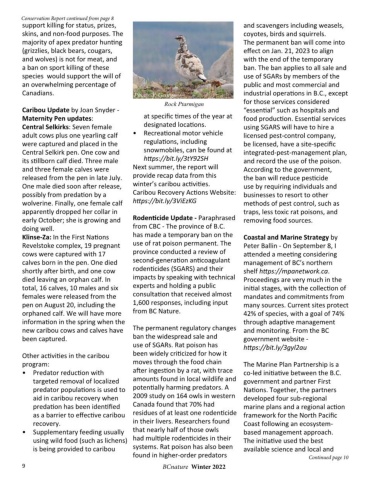
BCnature Winter 20229Conservation Report continued from page 8Continued page 10support killing for status, prizes, skins, and non-food purposes. The majority of apex predator hunting (grizzlies, lack ears, cougars, bband wolves) is not for meat, and a ban on sport killing of these species would support the will of an overwhelming percentage of Canadians. Caribou Update by Joan Snyder - Maternity Pen updates: Central Selkirks : Seven female adult cows plus one yearling calf were captured and placed in the Central Selkirk pen. One cow and its stillborn calf died. Three male and three female calves were released from the pen in late July. One male died soon after release, possibly from predation by a wolverine. Finally, one female calf apparently dropped her collar in early October; she is growing and doing well. Klinse-Za: In the First Nations Revelstoke complex, 19 pregnant cows were captured with 17 calves born in the pen. One died shortly after birth, and one cow died leaving an orphan calf. In total, 16 calves, 10 males and six females were released from the pen on August 20, including the orphaned calf. We will have more information in the spring when the new caribou cows and calves have been captured. Other activities in the caribou program: • Predator reduction with targeted removal of localized predator populations is used to aid in caribou recovery when predation has been identified as a barrier to effective caribou recovery. • Supplementary feeding usually using wild food (such as lichens) is being provided to caribou at specific times of the year at designated locations.• Recreational motor vehicle regulations, including snowmobiles, can be found at https://bit.ly/3tY92SHNext summer, the report will provide recap data from this winter’s caribou activities. Caribou Recovery Actions Website: https://bit.ly/3ViEzKG Rodenticide Update - Paraphrased from CBC - The province of B.C. has made a temporary ban on the use of rat poison permanent. The province conducted a review of second-generation anticoagulant rodenticides (SGARS) and their impacts by speaking with technical experts and holding a public consultation that received almost 1,600 responses, including input from BC Nature. The permanent regulatory changes ban the widespread sale and use of SGARs. Rat poison has been widely criticized for how it moves through the food chain after ingestion by a rat, with trace amounts found in local wildlife and potentially harming predators. A 2009 study on 164 owls in western Canada found that 70% had residues of at least one rodenticide in their livers. Researchers found that nearly half of those owls had multiple rodenticides in their systems. Rat poison has also been found in higher-order predators and scavengers including weasels, coyotes, birds and squirrels.The permanent ban will come into effect on Jan. 21, 2023 to align with the end of the temporary ban. The ban applies to all sale and use of SGARs by members of the public and most commercial and industrial operations in B.C., except for those services considered “essential such as hospitals and ”food production. Essential services using SGARS will have to hire a licensed pest-control company, be licensed, have a site-specific integrated pest-management plan, -and record the use of the poison. According to the government, the ban will reduce pesticide use by requiring individuals and businesses to resort to other methods of pest control, such as traps, less toxic rat poisons, and removing food sources.Coastal and Marine Strategy by Peter Ballin - On September 8, I attended a meeting considering management of BC’s northern shelf https://mpanetwork.ca. Proceedings are very much in the initial stages, with the collection of mandates and commitments from many sources. Current sites protect 42% of species, with a goal of 74% through adaptive management and monitoring. From the BC government website - https://bit.ly/3gyl2au The Marine Plan Partnership is a co-led initiative between the B.C. government and partner First Nations. Together, the partners developed four sub-regional marine plans and a regional action framework for the North Pacific Coast following an ecosystem-based management approach. The initiative used the best available science and local and Photo: V. GeorgeRock Ptarmigan


