


Page 6 - Demo
P. 6
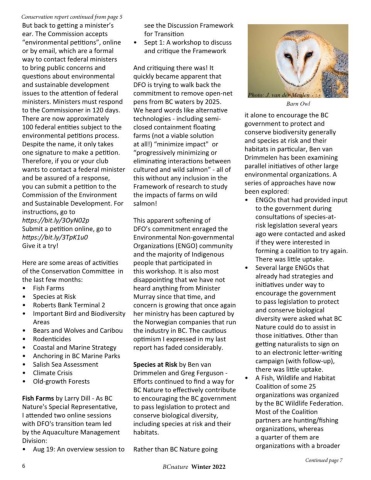
BCnature Winter 20226Continued page 7Conservation report continued from page 5But back to getting a minister’s ear. The Commission accepts “environmental petitions”, online or by email, which are a formal way to contact federal ministers to bring public concerns and questions about environmental and sustainable development issues to the attention of federal ministers. Ministers must respond to the Commissioner in 120 days. There are now approximately 100 federal entities subject to the environmental petitions process. Despite the name, it only takes one signature to make a petition. Therefore, if you or your club wants to contact a federal minister cultured and wild salmon - all of and be assured of a response, you can submit a petition to the Commission of the Environment and Sustainable Development. For instructions, go tohttps://bit.ly/3OyN02pSubmit a petition online, go to https://bit.ly/3TpK1u0Give it a try!Here are some areas of activities of the Conservation Committee in the last few months:• Fish Farms• Species at Risk• Roberts Bank Terminal 2• Important Bird and Biodiversity her ministry has been captured by Areas • Bears and Wolves and Caribou • Rodenticides • Coastal and Marine Strategy • Anchoring in BC Marine Parks • Salish Sea Assessment • Climate Crisis • Old-growth Forests Fish Farms by Larry Dill - As BC Nature s Special Representative, 'I attended two online sessions with DFO's transition team led by the Aquaculture Management Division:• Aug 19: An overview session to Rather than BC Nature going see the Discussion Framework for Transition• Sept 1: A workshop to discuss and critique the Framework And critiquing there was! It quickly became apparent that DFO is trying to walk back the commitment to remove open-net pens from BC waters by 2025. We heard words like alternative technologies - including semi-closed containment floating farms (not a viable solution at all!) “minimize impact\ or “progressively minimizing or eliminating interactions between ”this without any inclusion in the Framework of research to study the impacts of farms on wild salmon! This apparent softening of DFO’s commitment enraged the Environmental Non-governmental Organizations (ENGO) community and the majority of Indigenous people that participated in this workshop. It is also most disappointing that we have not heard anything from Minister Murray since that time, and concern is growing that once again the Norwegian companies that run the industry in BC. The cautious optimism I expressed in my last report has faded considerably.Species at Risk by Ben van Drimmelen and Greg Ferguson - Efforts continued to find a way for BC Nature to effectively contribute to encouraging the BC government to pass legislation to protect and conserve biological diversity, including species at risk and their habitats.it alone to encourage the BC government to protect and conserve biodiversity generally and species at risk and their habitats in particular, Ben van Drimmelen has been examining parallel initiatives of other large environmental organizations. A series of approaches have now been explored:• ENGOs that had provided input to the government during consultations of species-at-risk legislation several years ago were contacted and asked if they were interested in forming a coalition to try again. There was little uptake.• Several large ENGOs that already had strategies and initiatives under way to encourage the government to pass legislation to protect and conserve biological diversity were asked what BC Nature could do to assist in those initiatives. Other than getting naturalists to sign on to an electronic letter-writing campaign (with follow-up), there was little uptake.• A Fish, Wildlife and Habitat Coalition of some 25 organizations was organized by the BC Wildlife Federation. Most of the Coalition partners are hunting/fishing organizations, whereas a quarter of them are organizations with a broader Barn OwlPhoto: J. van der Meulen


