


Page 33 - Demo
P. 33
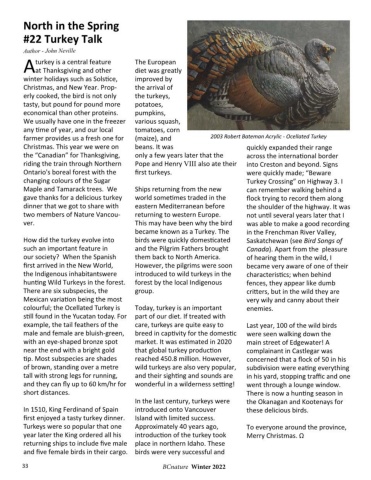
BCnature Winter 202233North in the Spring #22 Turkey TalkA turkey is a central feature at Thanksgiving and other winter holidays such as Solstice, Christmas, and New Year. Prop-erly cooked, the bird is not only tasty, but pound for pound more economical than other proteins. We usually have one in the freezer any time of year, and our local farmer provides us a fresh one for Christmas. This year we were on the “Canadian” for Thanksgiving, riding the train through Northern Ontario's boreal forest with the changing colours of the Sugar Maple and Tamarack trees. We gave thanks for a delicious turkey dinner that we got to share with two members of Nature Vancou-ver.How did the turkey evolve into such an important feature in our society? When the Spanish first arrived in the New World, the Indigenous inhabitantswere hunting Wild Turkeys in the forest. There are six subspecies, the Mexican variation being the most colourful; the Ocellated Turkey is still found in the Yucatan today. For part of our diet. If treated with example, the tail feathers of the male and female are bluish-green, with an eye-shaped bronze spot near the end with a bright gold tip. Most subspecies are shades of brown, standing over a metre tall with strong legs for running, and they can fly up to 60 km/hr for wonderful in a wilderness setting! short distances.In 1510 King Ferdinand of Spain ,first enjoyed a tasty turkey dinner. Turkeys were so popular that one year later the King ordered all his returning ships to include five male place in orthern Idaho. These and five female birds in their cargo. birds were very successful and The European diet was greatly improved by the arrival of the turkeys, potatoes, pumpkins, various squash, tomatoes, corn (maize), and beans. It was only a few years later that the Pope and Henry VIII also ate their first turkeys. Ships returning from the new world sometimes traded in the eastern Mediterranean before returning to western Europe. This may have been why the bird became known as a Turkey. The birds were quickly domesticated and the Pilgrim Fathers brought them back to North America. However, the pilgrims were soon introduced to wild turkeys in the forest by the local Indigenous group.Today turkey is an important , care, turkeys are quite easy to breed in captivity for the domestic market. It was estimated in 2020 that global turkey production reached 450.8 million. However, wild turkeys are also very popular, and their sighting and sounds are In the last century, turkeys were introduced onto Vancouver Island with limited success. Approximately 40 years ago, introduction of the turkey took nquickly expanded their range across the international border into Creston and beyond. Signs were quickly made; “Beware Turkey Crossing” on Highw y 3. I acan remember walking behind a flock trying to record them along the shoulder of the highway. It was not until several years later that I was able to make a good recording in the Frenchman River Valley, Saskatchewan (see Bird Songs of Canada). Apart from the pleasure of hearing them in the wild, I became very aware of one of theircharacteristics; when behind fences, they appear like dumb critters but in the wild they are , very wily and canny about their enemies.Last year, 100 of the wild birds were seen walking down the main street of Edgewater! A complainant in Castlegar was concerned that a flock of 50 in his subdivision were eating everything in his yard, stopping traffic and one went through a lounge window. There is now a hunting season in the Okanagan and Kootenays for these delicious birds.To everyone around the province, Merry Christmas. Ω Author - John Neville2003 Robert Bateman Acrylic - Ocellated Turkey


